
The City of Rockville is committed to keeping drinking water safe from lead. All water testing complies with federal rules, and no lead service lines have been found in the city.
In 1991, the Environmental Protection Agency (EPA) introduced the Lead and Copper Rule (LCR) to limit the amount of lead and copper in public drinking water and reduce pipe corrosion. The EPA strengthened the LCR by finalizing the Lead and Copper Rule Revision (LCRR) in January 2021 and Lead and Copper Rule Improvements (LCRI) in October 2024.
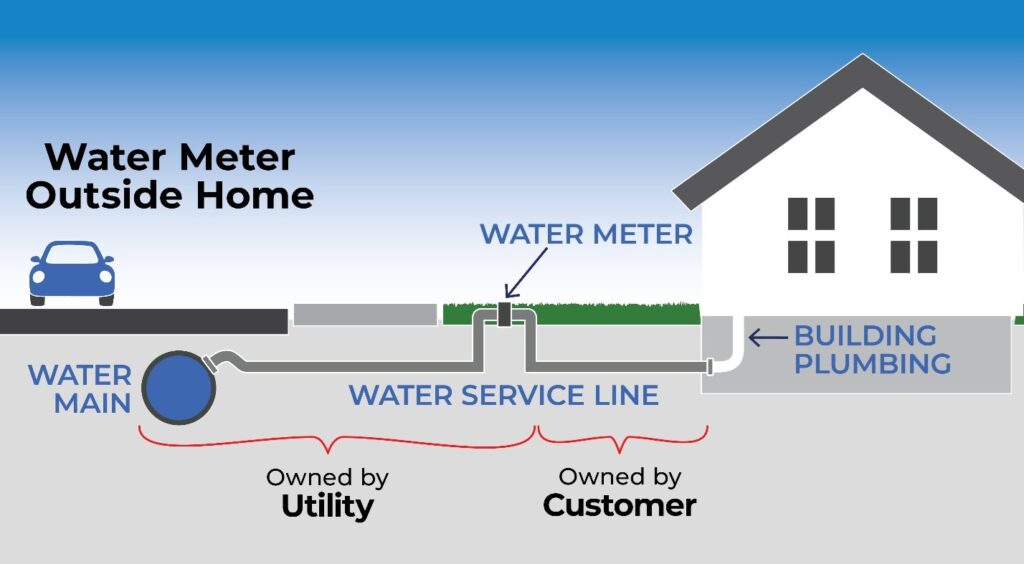
The city has followed LCR regulations since its implementation to ensure safe drinking water for residents and customers. The city is taking important steps in the national effort to protect consumers from lead in drinking water. The LCRR and LCRI require all water providers, including the City of Rockville, to identify and track all water service line materials in their water systems. This includes the utility or public side, which the city maintains, and the private side, which property owners maintain.
To follow the LCRR and LCRI, the City of Rockville has taken the following actions to inform and support residents and customers:
- Created an inventory of all service line materials on both the public and private sides through records review and customer survey. See the data in the Service Line Inventory Map section.
- Sent notification letters to customers with unknown service lines with steps on how to identify their service line. Find these steps in the Service Line Inventory Survey section.
- Sent notification letters to customers with service lines made of galvanized steel that may contain lead, also referred to as galvanized requiring replacement (GRR), with information on the steps they can take to protect against possible lead.
The city is expanding its efforts to include:
- Conducting service line inspections at select locations across the city to identify service line materials where records do not currently exist.
- Conducting predictive modeling to prioritize inspection locations and methods, such as in-home, meter pit, and test pit service line inspections. Learn more about these inspections in the Service Line Inspections section.
- Preparing a lead service line replacement plan.
- Checking and maintaining water treatment to prevent pipe corrosion.
- Preparing an expanded sampling plan to monitor lead levels at points across the system.
Service Line Inventory Map
Type your address into the Service Line Inventory Map to see information about the service line on your property.
Note: Not all Rockville addresses receive water from the city. Check your address in the Water Service Provider Map to see if your water is provided by the city or the Washington Suburban Sanitary Commission (WSSC Water). All City of Rockville actions and communications apply only to customers who receive water from the city. WSSC customers will be updated by WSSC. Rockville staff meet regularly with WSSC staff to coordinate and verify that all actions follow the EPA’s LCR.
Service Line Inventory Survey
The City of Rockville is working to identify service line materials and needs customer help identifying service lines with unknown materials. Follow the steps below to complete a survey. For further help, see the instructional guide or watch the instructional video.
Find the water service line pipe that enters your house.
Typically, service lines enter buildings from the street. Check your basement or crawlspace walls facing the street. If unsure, find the water meter cover at the property line to identify the entry point. The main water shut-off valve is usually found on this pipe.
Perform the magnet and scratch test on the pipe to determine the pipe material.
Take a clear photo of the pipe where it enters the building.
Make sure the photo clearly shows the point of entry. (See examples.) The survey system does not support HEIC photos. HEIC is the default format for many iPhone photos. Convert HEIC to a JPEG file format before uploading.
Complete the survey.
Visit bit.ly/waterlinerkv to complete the survey.
Service Line Inspections
Rockville is conducting in-home, meter pit, and test pit inspections for selected properties that have an unknown service line material. During the initial phases of inspections, the city selects properties for inspection using predictive modeling. By using a predictive model, the city can analyze inspection information from a strategically selected set of locations and apply results information to other properties with similar attributes such as year built, property type, and data. When there is enough inspection data, and the prediction is tested for accuracy, it can be used to assign “non-lead” status to locations where an inspection has not been conducted.
Contractors will place a door hanger on the front doors of selected properties to inform residents that crews will be working in the area in the coming months.
The type of inspection performed depends on the information needed to confirm the service line material. Inspections may include in-home, meter pit, or test pit inspections. Learn more about each type of inspection below. After the inspection, contractors will provide written inspection results and the identified service line material.
Water Sample Test Request
Rockville water service customers with unknown service line materials or GRR can request a lead test. Please note that water sampling, storage, and pickup must follow specific protocols.
Lead Service Line Replacement Plan
Rockville is developing a service line replacement plan based on inventory results, as required by the EPA. Currently, the system has no known lead service lines. The city does have a limited number of GRR service lines in the system. The EPA requires Rockville to fund replacement of the public side of a lead service line, if present. While the city does not have to fund the replacement of the private side of a lead or GRR service line, this will be reevaluated as additional data becomes available.
Frequently Asked Questions
contact
Jump To
Contact
Public Works Department
Engineering Division
240-314-8500
lcrr@rockvillemd.gov
Hours
Monday – Friday
8:30 a.m. – 5 p.m.
Address
Rockville City Hall
111 Maryland Ave.
Rockville, MD 20850